18 → 19 November 1943
The crash
Airborne at 17:30 with Berlin as target. Hit over Aachen, two engines shut down, and then a burning aircraft searching low over Haspengouw for a way out.
A double attack
The night of 18–19 November 1943 opened the Battle of Berlin: hundreds of bombers to the German capital, while a second stream attacked Ludwigshafen and Mannheim to split the night fighters. Berlin lay completely under cloud; the Pathfinders marked blind, through the overcast.
Long minutes at the controls
On the way home the aircraft was hit hard over Aachen. The port engine was knocked out and a second had to be shut down. Billows was wounded in the hand, Hesselden in the knee. Johnson dived, flew on past Liège and only ordered the crew out when the aircraft kept losing height. All six jumped. He did not, or jumped too late.
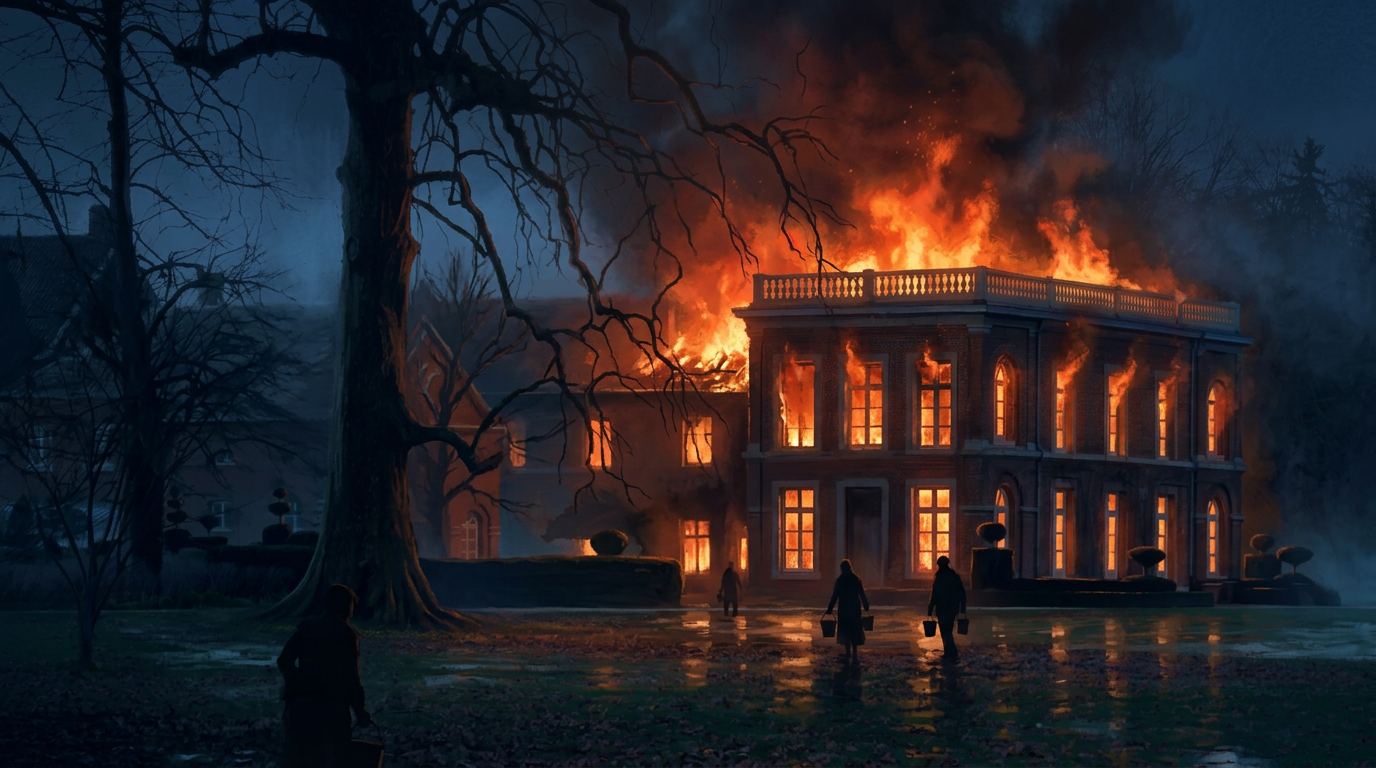
Those who looked up at Voort saw not an aircraft but a ball of fire coming over the Molenberg, turning above the wood and striking the roof of the castle. Witnesses spoke of a bang, then a yellow glow that lit up the whole village.
“The flak was so heavy and intense you could almost have walked on it.” — Charles John Billows, rear gunner
The morning after
The night, hour by hour
17:30
Bourn, Cambridgeshire
Take-off
Lancaster III JB 367 of 97 Squadron, Pathfinder Force, leaves Bourn with seven men aboard. Target: Berlin, in a double attack alongside Ludwigshafen and Mannheim. The H2S set appears to be working.
over the North Sea
English coast
25.000 ft
First failures
Barely across the coast, navigator Pepper finds the H2S radar dead. Bomb aimer Williams reports one of the front guns out of action.
en route
over Hannover
Turret out of action
Hesselden reports his mid-upper turret has stopped working. Johnson sends him forward to the nose gun; Williams throws out Window while Sansam watches for night fighters.
just before 21:00
Berlin
Bombs away
Berlin is completely cloud-covered. The Pathfinders mark with coloured flares glowing up through the overcast. JB 367 releases its bombs in salvo. Pepper lays the homeward course on wind and stars.
homebound
over Aachen
25.000 → 10.000 ft
Hit by flak
Heavy flak hits the port engine. Johnson dives from 25,000 to 10,000 feet, but the fire keeps up for four or five minutes. Splinters pierce wings and fuselage. Billows is wounded in the hand and his oxygen line is shot through.
shortly after
over Liège
Second engine shut down
A second engine has to be shut down to prevent fire. Over Liège another barrage; Hesselden is hit in the knee. Johnson orders his men to prepare to bail out.
≈22:15
over Haspengouw
8.000 → 6.000 ft
“Jump, bale out!”
The aircraft keeps sinking. One by one the six crew leave through the nose hatch and the fuselage, into thick fog and total darkness. Johnson stays at the controls.
≈22:30
Voort, Tornaco castle
Impact
Like a fireball the Lancaster comes in low over the Molenberg, turns above the wood and strikes the roof of the castle. It buries itself in the ground just in front of the building; a ruptured fuel tank sets everything ablaze. Two maids stand in the gutter of the roof, shouting that they will jump.
that night
Molenberg, Broekom
The pilot
Johnson jumped last, too low. After early mass, children from the Kapelstraat spread the news: the pilot lies dead in the meadow on the Molenberg, the cords of his parachute still on his back, shreds of silk in the branches.
19 November, 05:00
Widooie
A hand at the gate
Farmer Michel Paulissen steps out to his gate and sees a dark shape coming towards him. He pulls the navigator inside, gives him coffee and other clothes, and scatters lime at the gate to throw the tracker dogs off the scent.
Sources and links
- Aviation Safety Network — Lancaster III JB367
Loss record for JB 367.
- TracesOfWar — Crashlocatie Lancaster III JB 367 (OF-S) Voort
The crash site at Voort as a place you can visit.
Atmospheric illustration, not a historical photograph.